
Gilberto: "Dreams do come true. There are people working to help us achieve them."
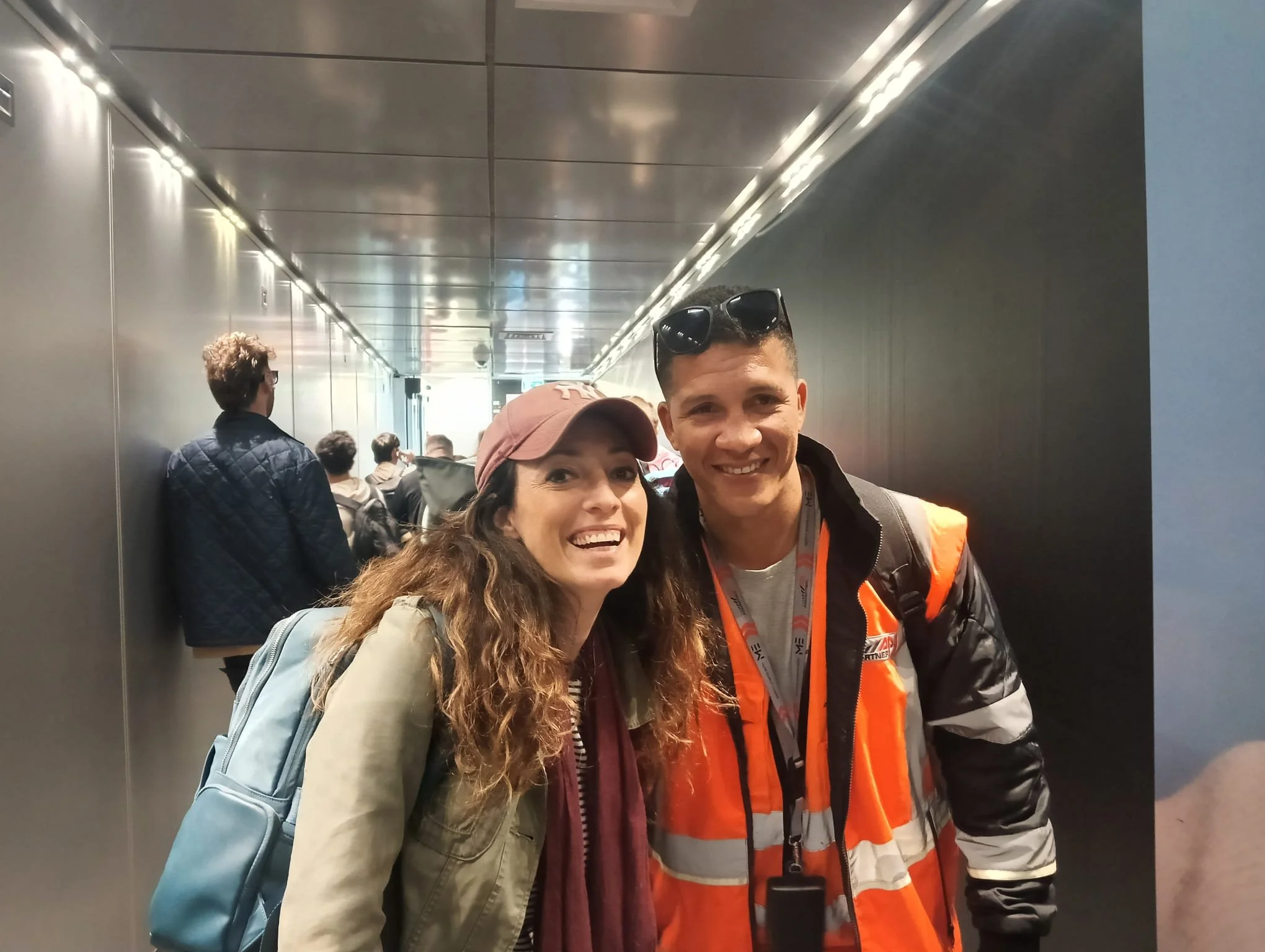
Gilberto and Stefania, TBB’s Italy Senior Programme Manager
There's a moment Gilberto keeps coming back to. He's standing on the tarmac at Fiumicino Airport, in uniform, looking up at the belly of an aircraft he's about to service. He has seen planes his whole life, but always from a distance, always looking up from the ground far below. Now he's close enough to touch one. He even gets invited into the cockpit.
"That was the most exciting thing," he says. "Back in Venezuela and Colombia, we'd always see planes, but from a distance. Being right under one, that close, it's something else."
Leaving Venezuela
Gilberto was born in Carúpano, a coastal city in Venezuela's Sucre State. In December 2021, he crossed into Colombia with his partner and their daughter, who was just sixteen months old. Unable to pass through official checkpoints, the family had to walk part of the route into Colombia and pay armed groups controlling the border area for safe passage.
Settling in Cali, Colombia, he took whatever work he could find — security guard, car wash attendant, construction worker. Employers turned him away from jobs specifically because he was Venezuelan. "It was hard, it was a tough start," he says. Even so, he kept looking for a way forward, applying to safe mobility programmes for the United States and Canada before eventually being accepted into a labour pathway to Italy.
A year of late nights
The call came in December 2024. "Wow, they remembered. They remembered the name Gilberto."
What followed was nearly a year of preparation. Gilberto and his cohort attended virtual Italian classes several nights a week. After full days of manual labour, they would rush home and study well into the night. Many dropped out along the way. Gilberto didn't.
"To say no, to give up after fighting so hard, after learning so much, it wasn't worth it."
The decision came at a cost. His partner told him plainly that she wasn't ready to leave Colombia. Gilberto made the difficult choice to go alone, trusting that he could reunite the family later.
Arriving in Italy
When Gilberto finally landed in Italy, the goodbye had been the hardest part. But what followed surprised him. His coworkers welcomed him warmly, including other Venezuelans already working there. "They tell me: 'I like Spanish, I want to learn Spanish, and I'll teach you Italian," he recalls. The exchange goes both ways.
Understanding colloquial Italian remains a daily challenge. Classroom Italian is nothing like being surrounded by native speakers talking at full speed. And the distance from his family weighs on him every day. He speaks with his daughter three times daily, timing calls around a six-hour difference so he can catch her waking up, arriving at school, and before he goes to sleep.
Looking forward
Gilberto's goals are practical, send remittances home to support his parents in Venezuela and his children in Colombia, save toward family reunification, and fly back to visit his youngest daughter when he can. He has also thought about giving back — volunteering one day to support others going through the same process he just completed.
For years, his father doubted him. The two often clashed. That has changed. "Every time I call him, there's someone nearby and he says: 'Hey, this is my son. He's in Italy.' He feels proud. It hurts him, because I'm far away, but he feels proud."
Asked what he would tell someone else considering a similar path, Gilberto doesn't hesitate. "Be persistent. Always fight for the dream. Dreams do come true. There are people working to help us achieve them. You have to pay a price — leaving things behind, family, friends, the life you lived. But when you get to where you want to go, when you find yourself in another culture, in another life, you will feel better. Little by little, things will change."
Arriving in Italy as a refugee after having gone through so many challenges, with a visa and a flight sponsored by a company, is truly transformative. It represents the recognition of one’s talents and skills, and it is a concrete response to a real need in the Italian labour market. If you’re interested in learning more, and Gilberto’s story has sparked your curiosity about labour mobility corridors, visit our Italy page.
About Talent Beyond Boundaries
Talent Beyond Boundaries is building a world where displaced people can safely migrate for work and fully realize their skills to rebuild their lives with dignity and purpose. Founded in 2016, TBB was the first organization in the world to focus on refugee labour mobility as a complementary pathway to traditional humanitarian resettlement. TBB's Talent Catalog, a world-first database, connects skilled displaced professionals with employers in Australia, Belgium, Canada, Germany, Ireland, Italy, the Netherlands, the UK and the US who need their skills.
The labour pathways in Italy are possible thanks to the collaboration of UNHCR, Diaconia Valdese, Pathways International and TBB, and are supported by ACRI – Associazione di Fondazioni e di Casse di Risparmio Spa, Fondazione Compagnia di San Paolo and The Human Safety Net, Fondazione Italiana Accenture, Reale Foundation, Fondazione Shapiro, Flora Fund and Fondo Beneficenza Intesa San Paolo, a testament to the growing commitment of the philanthropic and private sector to high-impact social initiatives.