
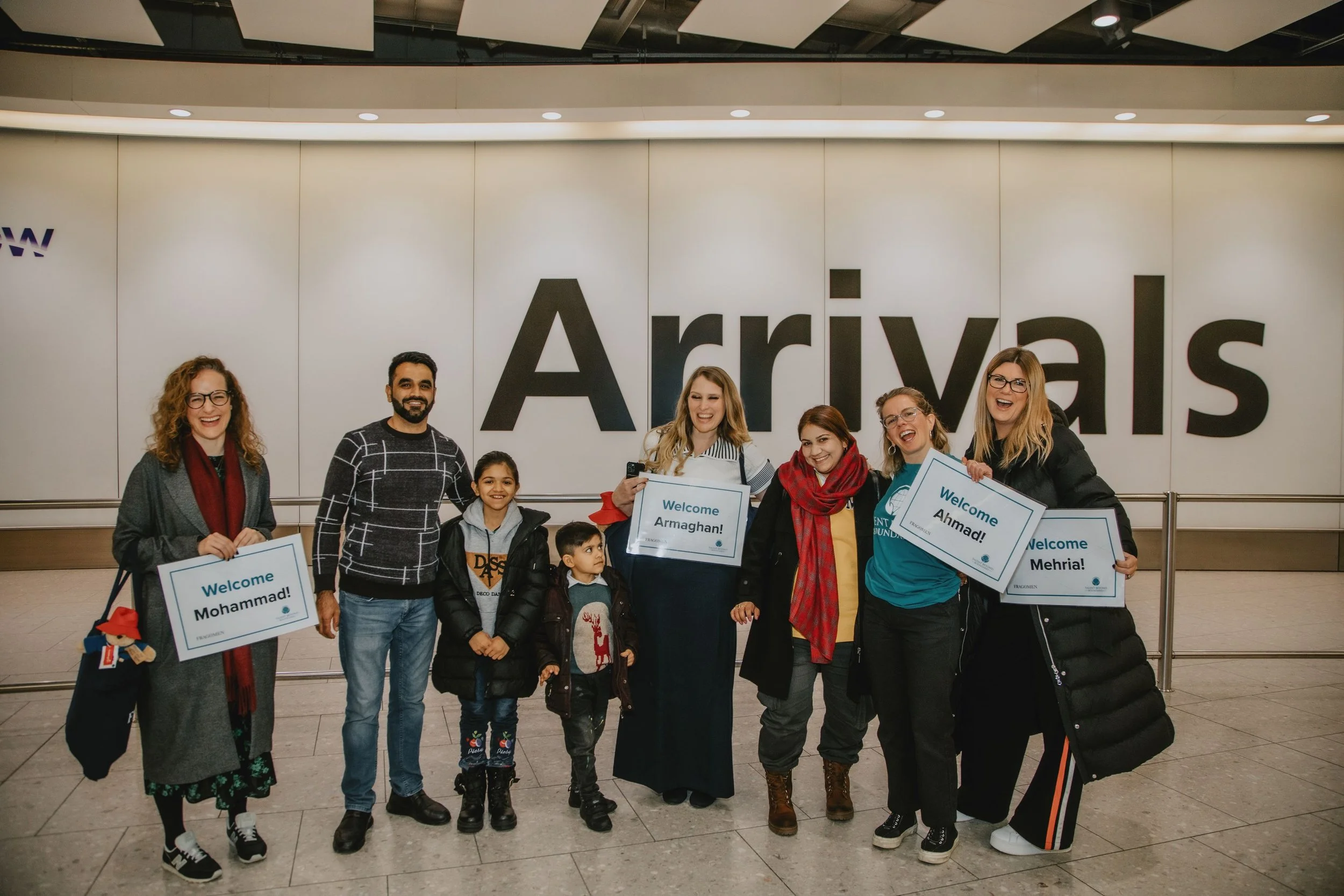
Mehria, a legal professional from Afghanistan, arriving in the UK with her family
After securing jobs abroad, skilled refugees send monthly remittances back home, which often surpass local incomes by 700%
When a skilled refugee secures a job abroad through Talent Beyond Boundaries (TBB), they don't just secure their own future. As job offers typically grant a work visa that includes their immediate family in the relocation, they secure their direct household's safety. This stable income then allows them to become a vital financial lifeline for extended family members who remain displaced, often in precarious circumstances. Candidates describe the money sent home as “life support” to cover their relatives’ food, housing, education and other basic needs. Our data reveals a critical financial commitment made by relocated displaced professionals:
84% of candidates surveyed are sending funds back home to support their families.
The amount sent by each person is an average of $430 USD per month, a life-changing sum in most contexts.
Based on this rate, the 600 candidates who have relocated to Australia, Canada, countries in the European Union, and the UK, could be injecting up to an estimated $200,000 USD every month into vulnerable displaced communities globally, or nearly $2.5 million USD per year.
Basic needs
The reasons for sending remittances are varied but fundamentally relate to family survival and community responsibility. Interviewed candidates highlighted the importance of sending money to countries like Lebanon and Syria, which are suffering from ongoing economic crises, high inflation, and the devaluation of their local currency. Because refugees in host countries often face legal barriers to formal employment and might only receive limited support from humanitarian aid, these funds could be the only guaranteed source of income.
The situation for Syrian families, for example, underscores this critical need. One candidate interviewed, Ahmad*, noted that without this money, his parents would be forced to "live on rice or basic food… The money it’s not really solving anything. It's just surviving." His family would also be unable to handle unexpected problems like house repairs. This level of support is essential given the average local salary in Syria is approximately $60 USD per month.
Investing in Futures and Fighting Emergencies
Beyond daily sustenance, the funds serve as both an emergency fund and a seed for future stability. Candidates consistently allocate funds toward siblings' education in school and university. One candidate supports his sister's $900 USD per semester university tuition and another paid for essential equipment like a brother's $2,000 new laptop. The dedication to funding tuition and technology supports the next generation to use these educational opportunities to potentially find their own paths out of displacement, or use these skills in their home or host countries.
Additionally, a number of candidates have sent large, irregular transfers to cover sudden crises. Because quality healthcare is often expensive and displaced families rarely have insurance, remittances are frequently used to establish a fund for health emergencies or to pay directly for necessary medical procedures. One candidate, Ismail*, described how even with five of his family members working, the wages are not enough to live on and he needed to send $200 USD to his mother to pay for her surgery. Large, unexpected expenses are also covered by these funds (e.g., a $2,000 USD transfer for urgent pipe repairs).
“[The] most important reason [to send money home] is after the outbreak of war in Syria my house got entirely destroyed and this made my family's financial situation worse. My case is one of thousands of cases like mine.” - Mahmoud*, TBB candidate
The extended safety net
Remittances from one individual can be a lifeline to support many people. For example, one candidate sending money to Syria supports seven individuals, two parents and five siblings. Another candidate, Mohammad*, sends $200 CAD per month to a family in Syria who he has never met. His mother-in-law connected him to send them money for basic needs such as food and clothes. He said “Now I think it's most important to send some money for Syrian families there because, seriously, without money they cannot do anything…” This highlights how the impact of a displaced person relocating for a work opportunity can reach further than immediate family members and one person can support many people in displacement. Many candidates feel that by sending remittances, they are also connected to their homeland which they may not be able to visit. For example, Mahmoud last visited Syria in 2014, and his description highlights the impact sending remittances have on the sender, not just the receiver: “Sending money to my family in Syria … there's a meaning to my life. There's something good I'm doing”.
Context: a financial multiplier
The $430 USD monthly average remittance is a transformative sustenance when benchmarked against the typical monthly incomes for the populations in the countries receiving the money. These figures show the financial significance of remittances in the top receiving countries:
These percentages represent massive shifts in quality of life. For a family in Syria or Sudan, receiving a remittance that is over seven times their average income could mean the difference between being able to feed their family nutritious meals, or access medical care. The consistent flow of money from relocated TBB candidates ensures not just individual self-reliance, but the survival and future prospects of entire family networks in crisis.
The hundreds of relocated TBB candidates represent life support for family and friends living in displacement. These funds don't just cover daily needs like food and rent; they also allow investments for future generations through securing education, and protection against crises such as medical emergencies where refugees often have little funds to pay for these irregular expenses. The sheer volume of this recurring support highlights the wider, systemic impact of labour mobility programmes, transforming the success of a few hundred individuals into a multi-country relief effort for hundreds (and potentially thousands) of refugees living in displacement. By connecting skilled individuals with international jobs, displaced talent mobility can translate directly into survival and hope for those forced to stay behind, making every job placement a continuous flow of stability and opportunity.
*Note: Names changed for privacy